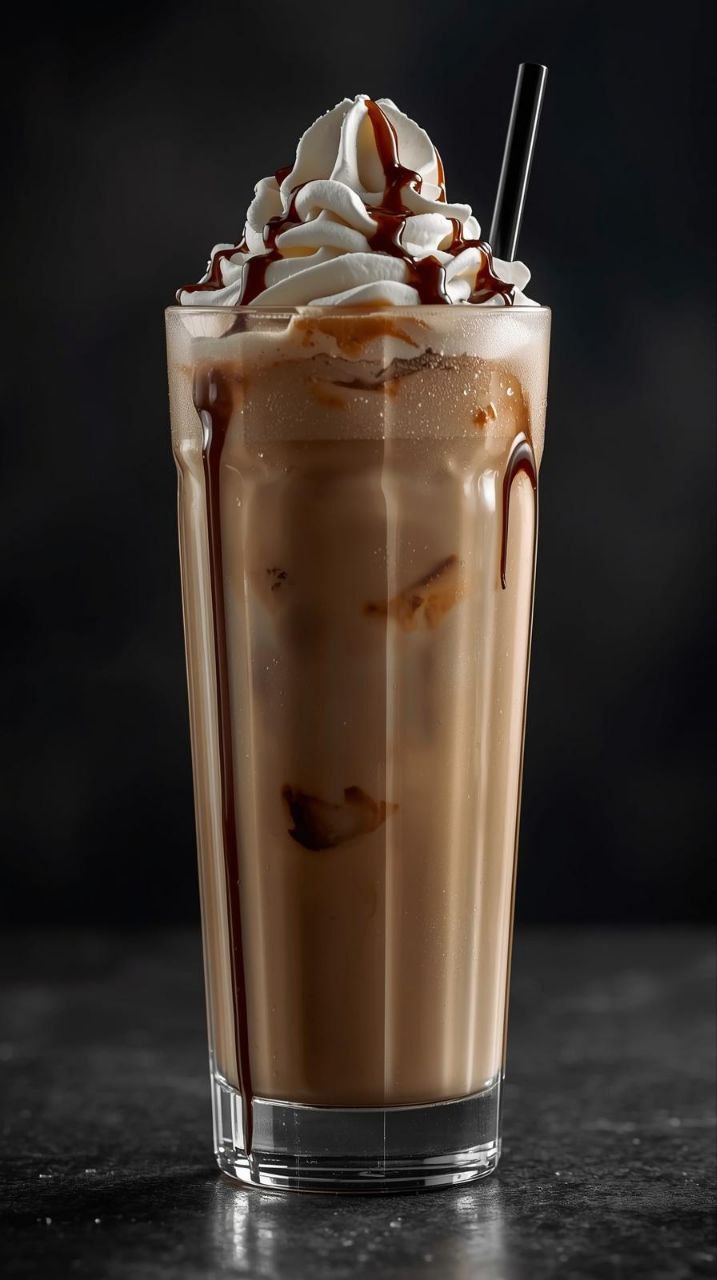
1. Structural Overview
Ingredient Leverage Lens
A Frappuccino is structurally an ice-stabilized emulsion system. Two ingredients do nearly all the work: ice (bulk + temperature control + thickness) and dairy fat/protein (emulsion stability + body). Everything else is secondary.
Most traditional or café-style Frappuccino recipes add syrups, stabilizers, gums, whipped cream, drizzles, and multiple flavor layers. These additions do not improve structure. They mainly increase sweetness or decoration while reducing predictability. Extra syrups dilute freezing behavior. Excess sugar lowers freezing point and creates slush instead of a clean, thick blend. Multiple fats destabilize the emulsion and separate during holding.
I remove all non-structural elements.
This version keeps only:
• liquid base
• ice
• coffee concentrate
• controlled sugar
• small fat source
That is sufficient to create the dense, smooth texture people expect from a Frappuccino, similar to the style popularized by Starbucks but without stabilizers or syrups.
The goal is not flavor complexity. The goal is predictable thickness, clean blending, and fast execution.
Success depends on:
• correct ice-to-liquid ratio
• limited sugar (freezing control)
• enough protein/fat to prevent separation
• short blend time to avoid heat buildup
I simplify to reduce decisions. Fewer variables produce repeatable results.
This Frappuccino is therefore not a dessert beverage. It is a controlled cold emulsion designed for stability.
2. Ingredient Function Analysis
Milk (whole or 2%)
Role: liquid phase + protein + mild fat + emulsification support
Why it stays: casein proteins stabilize air and micro-ice particles, preventing separation
Excluded: half-and-half, cream blends, plant thickeners
If removed: drink becomes icy and thin; rapid separation
Behavior: proteins create body under shear from blending; fat increases viscosity
Whole milk produces thicker texture. 2% is acceptable. Skim reduces stability.
Strong coffee (chilled concentrate)
Role: flavor + dissolved solids + slight bitterness to balance sugar
Why it stays: defines Frappuccino identity
Excluded: hot brewed coffee (adds heat, melts ice prematurely)
If removed: becomes milkshake without coffee structure
Behavior: dissolved solids increase viscosity slightly and improve body
Must be cold. Heat breaks the ice ratio.
Ice (cubed)
Role: primary structure + thickness + temperature control
Why it stays: replaces gums or stabilizers
Excluded: crushed ice (melts faster, inconsistent size)
If removed: becomes flavored milk
Behavior: fractures during blending, forming a semi-frozen slurry
Ice quantity determines thickness more than any other variable.
Sugar (granulated or simple syrup)
Role: sweetness + freezing point control
Why it stays: allows smooth blending instead of granular ice
Excluded: heavy syrups, honey, caramel sauces
If removed: texture becomes coarse and brittle
If excessive: becomes slushy and thin
Behavior: depresses freezing temperature, softens ice matrix
Small amounts only.
Optional: small pinch salt
Role: flavor stabilization
Why it stays: enhances perception of coffee without more sugar
Excluded: spices, extracts, decorative flavors
If removed: acceptable but flatter taste
Behavior: improves flavor clarity
Intentionally Excluded Components
• whipped cream
• chocolate drizzle
• xanthan/guar gum
• multiple syrups
• ice cream
• flavor powders
• protein powders
These either:
• add cleanup
• complicate blending
• destabilize freezing behavior
• provide no structural benefit
The minimalist ingredient set keeps the Frappuccino mechanically predictable.
3. Equipment Rationalization
Required
• blender
• measuring cup
• tall glass
Why only these
Blending is the only necessary transformation. No heating, steeping, or whipping.
Blender logic
A standard countertop blender is sufficient. High power is not required. Ice fracture happens with repeated pulses.
Avoid
• immersion blenders (poor ice fracture)
• food processors (inconsistent texture)
• milk frothers (air only, no ice control)
Heat source
None. All components must be cold.
If blender unavailable
Use pre-crushed ice in a jar and shake aggressively. Texture will be coarse but functional.
Extra tools only add cleaning time without improving structure.
4. Heat, Timing & Structural Control
This is a cold process, but thermal effects still matter.
Ice fracture behavior
If blending is too long → friction warms liquid → ice melts → drink thins
If blending too short → large fragments → gritty texture
Surface contact
Blades must contact liquid first. Dry ice cavitates and stalls blending.
Moisture evaporation
None intended. Lid prevents splashing and warming.
Internal doneness indicators
Correct texture appears when:
• vortex forms
• mixture thickens
• sound lowers from clatter to smooth churn
• surface becomes matte, not glossy
Carryover warming
After blending, melting continues. Serve immediately. Delay reduces thickness.
Cause and effect
If liquid ratio too high → thin
If sugar too high → slush
If milk too low → icy separation
If coffee warm → melts ice during blending
Structure depends on temperature control and ratios only.
5. Process (Clean Logical Flow)
Begin with fully chilled components. Cold milk and cold coffee prevent premature melting. Warm liquid reduces structural window.
Add liquid to blender first. This cushions blades and allows immediate circulation. Dry ice directly on blades causes erratic fracture and stalls movement.
Add sugar and salt into the liquid phase so they dissolve before ice incorporation. Undissolved sugar remains gritty and does not affect freezing behavior evenly.
Add measured ice last. Ice must sit partially submerged to start blending efficiently.
Pulse initially to fracture cubes. Large pieces break into smaller shards. At this stage the mixture is noisy and loose. Ice still discrete.
Transition to continuous blending only after fragments are small. Continuous shear distributes micro-ice evenly and incorporates slight air. The mixture thickens visibly. Color lightens due to air dispersion.
Stop as soon as the vortex slows and texture resembles wet cement. Additional blending only adds heat. Heat melts the ice lattice and reverses thickness.
Pour immediately. The Frappuccino should mound slightly before leveling. If it flows like milk, the ratio or temperature failed.
Drink within minutes. Structural integrity declines rapidly with time.
No garnish. Garnish adds weight and disrupts melt behavior.
The entire process should take less than two minutes.
6. Overcomplication Audit
Whipped cream topping
Adds decoration only. Collapses and dilutes drink. Requires extra equipment.
Multiple syrups
Increase sugar unpredictably. Lower freezing point. Texture becomes thin.
Ice cream addition
Creates dessert shake. Overpowers coffee and requires freezer management.
Flavor layering (caramel drizzle, chocolate streaks)
Pure decoration. No structural function. Adds cleanup.
Preheating coffee
Adds unnecessary thermal load. Destabilizes ice.
Blending in stages with transfers
Increases dishes and heat exposure. No benefit.
Each removed action reduces variability and improves repeatability.
7. Controlled Adaptations
Each change preserves timing and structure.
Chocolate Frappuccino
Replace 1 tablespoon sugar with 1 tablespoon cocoa powder. Maintains solids ratio.
Vanilla Frappuccino
Add 1/4 teaspoon vanilla extract only. No syrup.
Oat milk swap
Use barista-style oat milk only. Similar protein stabilizes texture. Thin versions separate.
Decaf
Replace coffee with decaf concentrate. Structure unchanged.
One modification at a time.
8. Storage & Structural Stability
Immediate consumption is optimal.
Over time
Ice melts
Water separates
Emulsion collapses
Refrigeration
Becomes sweet milk. Cannot restore original thickness without re-blending and new ice.
Freezing
Forms solid block. Re-blending produces coarse texture.
Moisture migration
Liquid drains downward; foam rises.
Reheating
Not applicable.
This Frappuccino is intentionally short-lived. Stability window: 5–10 minutes.
9. Efficiency FAQ
Can I skip chilling the coffee?
No. Warm coffee melts ice and thins structure.
Can I double the recipe?
Yes, if blender volume allows full circulation.
Can I reduce sugar?
Yes, but texture becomes icier.
Can I reduce fat?
Yes, but separation increases.
Can I prep ahead?
No. Blend only when serving.
Why is it watery?
Too much liquid or over-blended heat.
10. Minimal Recipe Card
Recipe Name
Frappuccino (Minimal Structural Version)
Prep Time
3 minutes
Cook Time
0 minutes
Total Time
3 minutes
Servings
1 large
Ingredients
• 1 cup cold milk
• 1/2 cup strong cold coffee
• 1 1/2 cups ice cubes
• 1–2 tablespoons sugar
• pinch salt
Method
- Add milk, coffee, sugar, and salt to blender.
- Add ice.
- Pulse to fracture ice, then blend until thick and smooth.
- Stop immediately once thickened.
- Pour and serve.

Hi, I’m Olivia Bennett. I approach home cooking with a focus on structure, heat control, and efficiency.
I believe most recipes become complicated because unnecessary steps and decorative ingredients are added without purpose. In my kitchen, I reduce dishes to their essential functional components. I prioritize technique over quantity, clarity over tradition, and repeatable results over presentation.
The recipes I share are designed to be structurally reliable. I focus on moisture balance, timing predictability, and heat behavior so that each dish performs consistently without excess steps or supervision.
This is efficient home cooking built on cause-and-effect logic — fewer ingredients, better results.