1. Structural Overview
Structural Blueprint Lens
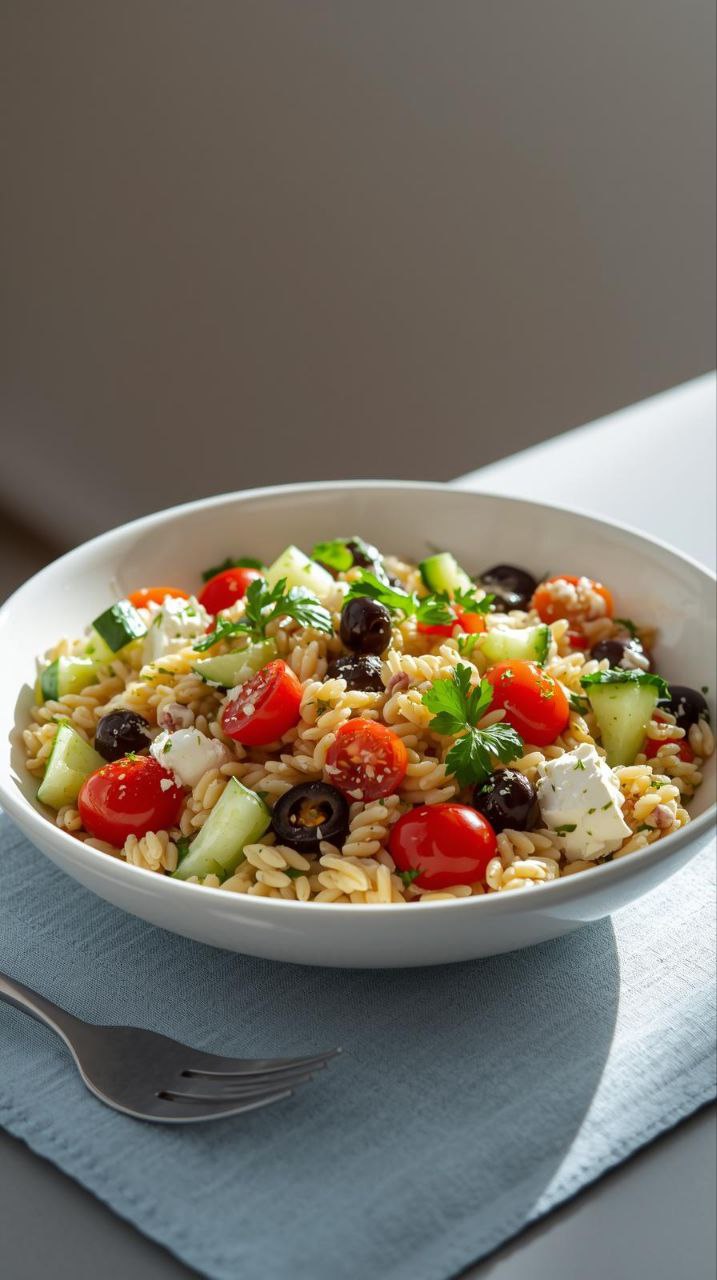
Greek orzo salad is a starch-gel system stabilized by fat and acid.
The structure is not built from greens or toppings. It is built from hydrated pasta that sets into discrete, non-sticky grains, then coated with oil to prevent surface starch bonding. Acid and salt stabilize flavor and tighten vegetable texture. Cheese adds localized fat and protein density that interrupts clumping.
The system holds if three conditions are met:
• Orzo fully hydrated but not ruptured
• Surface starch rinsed or diluted
• Oil applied early to create separation
If these fail, the salad compresses into a single mass.
Traditional versions add excess components: multiple herbs, leafy greens that wilt, sugary dressings, olives plus marinated vegetables plus extra cheeses. These introduce water migration and instability. The result is soggy pockets and uneven salt distribution.
I remove anything that does not contribute to:
• separation
• moisture control
• acid balance
• structural stability after refrigeration
This version reduces the dish to pasta + firm vegetables + brine element + fat + acid + salt + one protein-rich cheese.
The goal is a free-flowing, scoopable Greek orzo salad that remains stable for hours at room temperature and days in the refrigerator.
No garnish. No layers. No secondary sauces.
Just a controlled starch system with predictable behavior.
2. Ingredient Function Analysis
Orzo (dry)
Role: Primary structure; starch-gel backbone
Why it stays: Defines the dish; provides bulk and hydration capacity
Behavior: Absorbs water, gelatinizes, sets into firm grains
If removed: No structural base; becomes chopped vegetable salad
Heat behavior: Overcooking ruptures starch → stickiness
Notes: Slightly undercook to maintain separation
Excluded: Larger pasta shapes
Reason: Larger shapes trap dressing internally, create uneven distribution, and reduce scoopability.
Water (for boiling)
Role: Hydration medium
Why it stays: Necessary for starch gelatinization
Behavior: Transfers heat and hydrates pasta
If reduced: Uneven cooking, surface stickiness
Excluded: Broth
Reason: Adds unnecessary flavor complexity and salts unevenly.
Salt (boiling + dressing)
Role: Flavor stabilization; mild protein tightening in vegetables
Why it stays: Controls taste perception
If removed: Flat flavor; dressing tastes diluted
Behavior: Dissolves uniformly
Excluded: Flavored salts
Reason: Inconsistent intensity.
Olive oil
Role: Fat coating; separation agent; flavor carrier
Why it stays: Prevents pasta adhesion by lubricating starch surfaces
If removed: Clumping occurs during cooling
Heat behavior: No cooking required; applied warm for better coating
Excluded: Creamy dressings, mayonnaise
Reason: Emulsion traps water and increases spoilage risk.
Red wine vinegar or lemon juice
Role: Acid; flavor contrast; vegetable firmness
Why it stays: Tightens cell walls, reduces perceived heaviness
If removed: Oily, dull flavor
Behavior: Balances fat
Excluded: Sugary dressings
Reason: Sugar increases stickiness and masks structure.
Cucumber (firm, seeded)
Role: Moisture + crunch
Why it stays: Provides water release with structural integrity
Behavior: Low starch, high water, stable when salted lightly
If removed: Texture becomes monotone
Risk: Excess seeds release water
Excluded: Lettuce
Reason: Wilts and collapses.
Cherry tomatoes (halved)
Role: Controlled acidity + moisture pockets
Why it stays: Adds intermittent juiciness
Behavior: Gradual water release into dressing
If removed: Salad feels dry
Risk: Too many create pooling
Red onion (small dice)
Role: Sharp aromatic contrast
Why it stays: High impact at low volume
Behavior: Acid softens bite
If removed: Flavor lacks structure
Excluded: Multiple herbs + scallions
Reason: Redundant sharpness.
Feta (firm block, cubed)
Role: Protein + fat nodes; salt concentration points
Why it stays: Provides structural interruption and density
Behavior: Does not melt; holds shape
If removed: Salad lacks weight and savory anchor
Heat behavior: None; cold-stable
Excluded: Soft cheeses
Reason: Smearing increases clumping.
Dried oregano
Role: Aromatic signal
Why it stays: Strong, low-moisture flavor source
If removed: Profile less defined
Excluded: Fresh herb mix
Reason: Adds water and variability.
Total ingredient count: 10
Each performs a structural function. Nothing decorative.
3. Equipment Rationalization
Required:
• One pot
• Colander
• One large mixing bowl
• Knife
• Cutting board
• Spoon
The pot hydrates starch.
The colander removes excess surface starch.
The bowl allows coating and distribution.
No blender.
No dressing jar.
No mandoline.
No extra pans.
Heat source: standard stovetop.
If no colander: drain carefully and rinse directly in pot with cold water.
Large shallow bowl preferred because surface area improves even oil distribution and faster cooling.
Additional tools only increase cleaning without improving structure.
4. Heat, Timing & Structural Control
Browning is not required. This is hydration control.
Boiling phase
If heat is too low → pasta absorbs water slowly → exterior overhydrates → mushy surface.
If heat is too high but water insufficient → uneven cooking.
Use vigorous boil for consistent movement.
Evaporation
Drain immediately. Residual hot water continues cooking.
Surface starch
If not rinsed or cooled quickly → starch gel forms glue → clumping.
Oil application
Warm pasta absorbs oil better. If oil added cold after clumping, separation is incomplete.
Vegetable moisture
Salt draws water slowly. Too much salt early → pooling liquid.
Cooling
Carryover heat softens vegetables if mixed too soon.
Target: pasta warm, not hot, before combining.
Structure is stable once fully cooled and coated.
5. Process (Clean Logical Flow)
Water comes to a full boil with salt dissolved. The orzo enters and disperses immediately. Movement prevents settling. The pasta swells, turns opaque, then softens internally while remaining intact externally. Cooking stops just before full tenderness so the core still offers slight resistance.
The orzo drains. Residual steam escapes. A brief rinse removes free starch and halts cooking. Surface becomes matte rather than sticky.
While still warm, olive oil is added. Stirring spreads a thin fat layer over each grain. Separation becomes visible. Grains slide instead of clumping.
Vegetables are cut to uniform small size. Equal dimensions ensure even distribution and consistent bite. Cucumber seeds are removed to limit free water. Tomatoes are halved to expose interior but not crushed.
Acid, salt, and oregano combine directly with the pasta first. This ensures seasoning reaches the base rather than just the surface toppings.
Vegetables fold in gently. Moisture disperses into oil-acid mixture, forming a light coating rather than a pool.
Feta is added last to avoid crumbling. Cubes remain distinct.
The mixture rests. Temperature drops. Starch firms. Oil sets. The salad becomes free-flowing.
Greek orzo salad is ready when spooned portions separate cleanly.
6. Overcomplication Audit
• Multiple fresh herbs — inconsistent moisture and flavor spikes
• Olive tapenade or spreads — excessive salt and oil concentration
• Marinating vegetables — unnecessary time and water loss
• Roasted vegetables — adds heat stage without structural benefit
• Creamy dressings — trap water and reduce shelf life
• Garnishes — visual only; no structural function
Each adds steps or instability without improving the core starch system.
7. Controlled Adaptations
• Swap feta for firm halloumi cubes — similar density
• Swap cucumber for blanched green beans — similar moisture
• Use whole wheat orzo — similar cooking behavior
• Replace vinegar with lemon — equivalent acidity
• Add chickpeas (small amount) — similar structural density
One change at a time only.
8. Storage & Structural Stability
After refrigeration, starch retrogrades and firms. Texture becomes slightly tighter.
Oil thickens at low temperature but liquefies when stirred.
Vegetables release gradual moisture, slightly loosening dressing.
Stable for 3–4 days.
Freezing not recommended. Starch gel fractures and becomes mealy.
Reheating unnecessary. Room temperature restores optimal texture.
Once mushy from overcooking, structure cannot be restored.
9. Efficiency FAQ
Can I skip rinsing?
No. Surface starch causes clumping.
Can I double the recipe?
Yes. Use larger bowl for proper coating.
Can I reduce oil?
Slightly. Too little increases sticking.
Can I reduce salt?
Yes, but flavor flattens.
Can I make ahead?
Yes. Improves after 1 hour.
Why is it sticky?
Overcooked or insufficient oil.
10. Minimal Recipe Card
Greek Orzo Salad
Prep Time: 15 minutes
Cook Time: 10 minutes
Total Time: 25 minutes
Servings: 4–5
Ingredients
• 1 cup dry orzo
• 1 tbsp salt (for water)
• 3 tbsp olive oil
• 2 tbsp red wine vinegar or lemon juice
• 1 cup cucumber, diced
• 1 cup cherry tomatoes, halved
• 1/4 cup red onion, small dice
• 3/4 cup feta, cubed
• 1 tsp dried oregano
• Salt to taste
Method
- Boil salted water. Cook orzo until just tender.
- Drain and rinse briefly.
- While warm, toss with olive oil.
- Add vinegar, oregano, salt. Mix.
- Fold in vegetables.
- Add feta last.
- Cool before serving.
This Greek orzo salad remains structurally reliable, uses fewer ingredients for better results, and supports efficient home cooking with minimal cleanup.

Hi, I’m Olivia Bennett. I approach home cooking with a focus on structure, heat control, and efficiency.
I believe most recipes become complicated because unnecessary steps and decorative ingredients are added without purpose. In my kitchen, I reduce dishes to their essential functional components. I prioritize technique over quantity, clarity over tradition, and repeatable results over presentation.
The recipes I share are designed to be structurally reliable. I focus on moisture balance, timing predictability, and heat behavior so that each dish performs consistently without excess steps or supervision.
This is efficient home cooking built on cause-and-effect logic — fewer ingredients, better results.