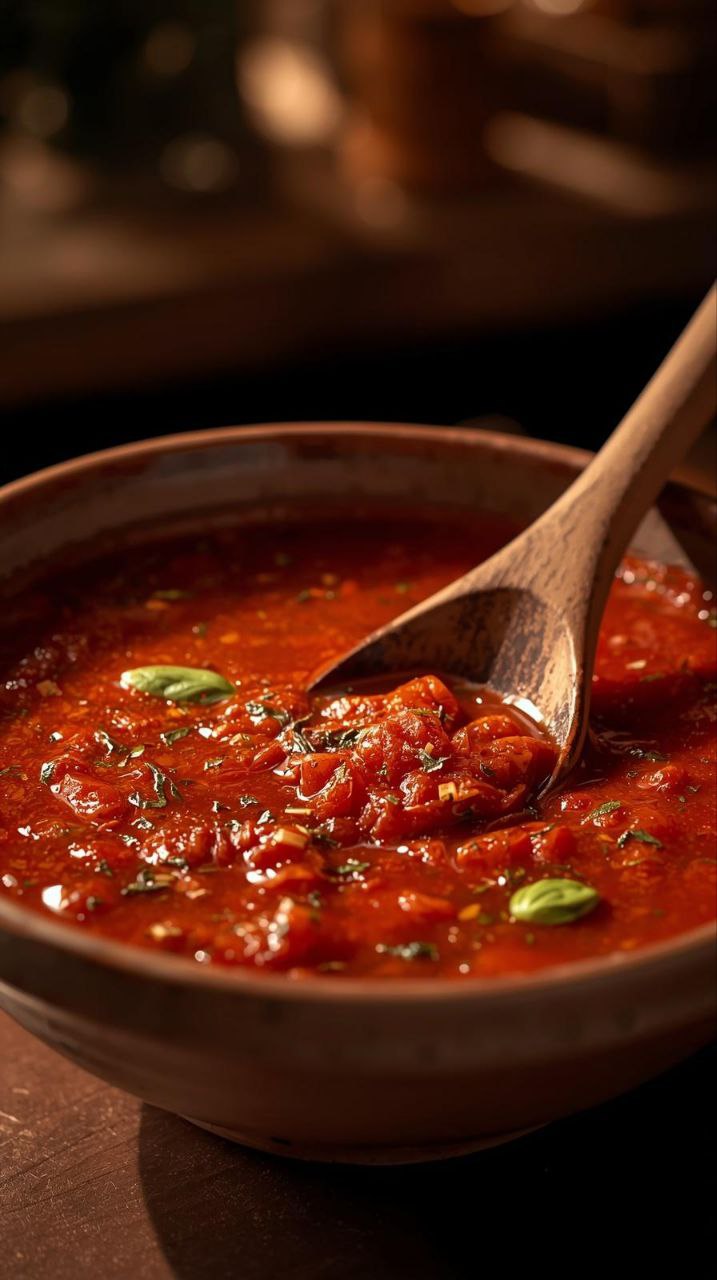
1. Structural Overview
Heat Behavior Lens
Marinara sauce is a controlled evaporation system.
Its structure is defined by how water leaves the tomatoes and how solids concentrate. There is no thickener. No starch. No roux. No cream. The final texture comes from reduction alone.
Tomatoes begin as mostly water. Heat breaks cell walls, releases pectin, and allows moisture to evaporate. As evaporation progresses, suspended solids concentrate and viscosity increases. Flavor intensifies at the same rate. If evaporation is too slow, the sauce stays watery. If heat is too aggressive, sugars scorch before the water has time to leave.
The success of marinara sauce depends on three behaviors:
• steady simmer
• gradual moisture loss
• limited agitation
When these are controlled, the sauce thickens naturally without additives.
Traditional versions often include long ingredient lists: wine, sugar, multiple herbs, carrot, celery, stock, tomato paste, butter finishes. These compensate for weak tomato flavor or poor reduction control. They are structural noise.
I remove anything that does not directly affect reduction, stability, or salt–acid balance.
This version keeps only:
• tomatoes
• fat
• garlic
• salt
• controlled heat
It is simplified from traditional multi-ingredient sauces. Nothing is added for decoration or tradition.
Marinara sauce works because tomato solids concentrate while fat distributes flavor and prevents scorching. The result is a sauce that coats pasta predictably, reheats reliably, and requires minimal monitoring.
It is not built. It is reduced.
2. Ingredient Function Analysis
Tomatoes (whole peeled canned or crushed)
Functional role:
Primary structure, moisture source, acidity, natural pectin thickening.
Why it stays:
Tomatoes define the system. Everything else supports their reduction.
Heat and texture behavior:
Heat ruptures cell walls → water releases → pectin disperses → solids concentrate → viscosity increases. Extended simmer deepens sweetness as acids mellow.
What was intentionally excluded:
Fresh tomatoes out of season, tomato paste, sugar, stock, wine.
Why excluded:
Fresh tomatoes vary in water content and sweetness, causing unpredictable reduction times. Paste accelerates thickness but creates pasty density instead of clean reduction. Sugar masks under-reduction. Stock and wine dilute structure.
If removed:
No sauce. Nothing to reduce.
Olive Oil
Functional role:
Fat distribution, heat buffering, flavor carrier, surface protection.
Why it stays:
Fat prevents garlic scorching and distributes fat-soluble flavors across the sauce.
Heat behavior:
Oil coats solids, slowing localized overheating and reducing sticking on the pan base. It moderates thermal spikes during simmer.
What was intentionally excluded:
Butter, cream, finishing fats.
Why excluded:
Dairy emulsifies and softens acidity but destabilizes storage life and reheating behavior. Marinara is designed as a stable tomato reduction, not an emulsion.
If removed:
Garlic burns faster. Sauce tastes sharp and thin. Mouthfeel decreases.
Garlic
Functional role:
Aromatic base, mild sweetness after heat, flavor depth.
Why it stays:
Provides foundational savory notes with minimal ingredients.
Heat behavior:
Gentle sauté converts raw sulfur compounds into sweeter compounds. If browned too far, bitterness appears and spreads through the sauce.
What was intentionally excluded:
Onion, shallot, mirepoix, herb bundles.
Why excluded:
Extra vegetables add water, increasing reduction time and blurring tomato clarity. This sauce prioritizes speed and predictability.
If removed:
Sauce tastes flat but still functions structurally.
Salt
Functional role:
Flavor stabilization, moisture regulation, perceived thickness.
Why it stays:
Salt balances acidity and enhances tomato sweetness.
Heat behavior:
Salt draws moisture from tomato tissue early, accelerating breakdown and integration.
What was intentionally excluded:
Soy sauce, stock concentrates, complex seasonings.
Why excluded:
They introduce competing flavors and unnecessary complexity.
If removed:
Sauce tastes acidic and thin even if reduced properly.
Optional: Dried Oregano or Basil (minimal)
Functional role:
Aromatic accent only.
Why limited:
Herbs should not dominate structural clarity.
If overused:
Sauce becomes herbal rather than tomato-forward.
Total ingredient count: 4–5 essential items.
Everything else is decorative or compensatory.
3. Equipment Rationalization
Required
Heavy-bottom pot or saucepan
Provides even heat distribution. Prevents scorching during long reduction. Thermal mass buffers fluctuations.
Wooden spoon or heat-safe spatula
For occasional scraping and agitation. Prevents sticking.
Stove heat source
Stable low-to-medium control required.
Why additional tools are unnecessary
No blender required. Texture comes from tomato breakdown during simmer.
No strainer. Seeds and pulp contribute body.
No slow cooker. Excessively slow heat prolongs evaporation and wastes time.
No pressure cooker. High pressure traps moisture, opposing reduction.
No food processor. Mechanical breakdown makes sauce watery initially and extends cook time.
Pan selection logic
Wide surface area accelerates evaporation. Narrow pots slow reduction. A moderately wide saucepan balances evaporation speed with splatter control.
If unavailable, use any pot with a thick base. Increase time rather than heat.
4. Heat, Timing & Structural Control
Browning behavior
Only garlic browns. Tomatoes should not fry.
If garlic browns deeply, bitterness spreads through the sauce and cannot be removed.
Surface contact
Direct oil-to-garlic contact ensures flavor extraction. After tomatoes are added, solids suspend in liquid and surface browning stops.
Moisture evaporation
Steady simmer creates small, consistent bubbles. These allow gradual water loss.
If heat is too low → evaporation slows → watery sauce.
If heat is too high → splattering, scorching, uneven thickening.
Internal doneness indicators
Sauce thickens enough to:
• coat spoon
• leave a line when dragged
• fall in slow sheets, not drips
These signals mean solids have concentrated sufficiently.
Carryover cooking
After heat is off, residual heat continues thickening for several minutes. Final texture sets slightly thicker than at flame.
If reduced exactly to target on heat, it becomes too thick while resting.
5. Process (Clean Logical Flow)
Oil enters the pan first and heats gently. Garlic goes into warm oil, not hot oil. The goal is softening, not browning. The aroma shifts from sharp to sweet. Color remains pale.
Tomatoes enter next. Their moisture immediately drops the temperature and halts browning. The mixture becomes loose and watery. Large pieces begin breaking apart with stirring.
Salt dissolves and pulls moisture outward. Liquid level appears high at first. This is expected.
Heat rises to a steady simmer. Small bubbles appear across the surface. Large rolling boils are avoided because they throw solids upward and cause scorching at the base.
During the first phase, tomatoes break down. Chunks soften and collapse. Stirring frequency stays low to avoid cooling the surface. Every few minutes, the bottom is scraped to prevent sticking.
In the second phase, liquid visibly reduces. Bubble size increases as water content drops. The sauce darkens slightly. Splatter risk rises because thicker sauce traps steam. Heat may be reduced slightly to maintain controlled bubbling.
In the final phase, viscosity increases quickly. Movement slows. Dragging a spoon leaves temporary tracks. Aromas concentrate.
Heat is cut slightly before the final thickness is reached. Carryover reduction completes the texture.
The result is cohesive, spoon-coating, and stable without thickeners.
6. Overcomplication Audit
• Adding sugar to “fix” acidity — masks under-reduction instead of solving it
• Using tomato paste — creates artificial thickness and pasty texture
• Adding mirepoix — introduces excess water and extends cook time
• Blending repeatedly — adds air and thins structure
• Simmering for hours — unnecessary once reduction target is reached
• Finishing with butter — changes system to emulsion and reduces storage stability
Each action adds steps without improving structural integrity.
7. Controlled Adaptations
• Crushed red pepper — adds heat without affecting structure
• Dried oregano — low-moisture aromatic, no timing impact
• Cherry tomato version — similar moisture ratio, same reduction method
• Garlic powder substitute — usable if fresh unavailable, added after tomatoes
Each change keeps heat behavior and timing stable.
8. Storage & Structural Stability
Cooling thickens further as pectin sets.
Refrigeration causes slight gel formation. Reheating reverses it.
Moisture may separate slightly after freezing. Stirring restores cohesion.
Texture remains stable 4–5 days refrigerated.
Over-reduction cannot be reversed except by dilution.
9. Efficiency FAQ
Can I skip preheating oil?
No. Cold oil slows garlic softening and increases scorching risk.
Can I double the recipe?
Yes. Use wider pot or extend reduction time.
Can I reduce oil?
Yes, but garlic burns faster and mouthfeel decreases.
Can I cook ahead?
Yes. Texture stabilizes after resting.
Why is it watery?
Insufficient evaporation.
Why bitter?
Garlic browned too far or sauce scorched.
10. Minimal Recipe Card
Recipe Name: Marinara Sauce
Prep Time: 5 minutes
Cook Time: 30–40 minutes
Total Time: 40–45 minutes
Servings: 4 cups
Ingredients
• 2 tbsp olive oil
• 4 cloves garlic, sliced
• 28 oz canned whole tomatoes
• 1–1.5 tsp salt
• optional dried oregano
Method
- Warm oil in heavy saucepan over medium-low heat.
- Add garlic. Soften until fragrant, not browned.
- Add tomatoes and salt. Crush lightly.
- Simmer uncovered at steady gentle bubbles. Stir occasionally.
- Reduce until spoon-coating thickness forms.
- Remove from heat slightly early. Rest 5 minutes.
Serve or store.
This marinara sauce relies on controlled evaporation and minimal inputs. Fewer ingredients, better results. A structurally reliable recipe for efficient home cooking.

Hi, I’m Olivia Bennett. I approach home cooking with a focus on structure, heat control, and efficiency.
I believe most recipes become complicated because unnecessary steps and decorative ingredients are added without purpose. In my kitchen, I reduce dishes to their essential functional components. I prioritize technique over quantity, clarity over tradition, and repeatable results over presentation.
The recipes I share are designed to be structurally reliable. I focus on moisture balance, timing predictability, and heat behavior so that each dish performs consistently without excess steps or supervision.
This is efficient home cooking built on cause-and-effect logic — fewer ingredients, better results.